How the Anagen, Catagen, and Telogen make up the Hair Growth Cycle
Summary
Hair grows through a natural cycle of anagen (growth), catagen (transition), telogen (resting), and exogen (shedding). Each phase plays a different role, and changes in the balance of these stages can affect how much hair is shed or the speed hair grows.
Understanding the hair cycle helps explain why some shedding is normal, while other changes may be linked to conditions such as telogen effluvium or other forms of hair loss.
Each scalp follicle follows its own natural cycle, with different follicles at different stages at any one time. This cycle is commonly described in four phases: anagen (growth), catagen (transition), telogen (resting), and exogen (shedding).
Changes in the balance of these phases can influence how much hair is shed and how dense the hair appears.
What Are the Stages of the Hair Growth Cycle?
| Phase | What Is Happening? | Typical Duration on the Scalp |
|---|---|---|
| Anagen | The hair follicle is actively growing and producing new hair. | Around 2–7 years |
| Catagen | Growth halts as the follicle moves through a short transition period. | 2–4 weeks |
| Telogen | The follicle rests while the existing hair remains in place. | ~3 months (100 days) |
| Exogen | The old hair strand is naturally released and shed from the scalp. | Variable – the shedding phase |
Note: These timings are approximate. Hair cycles vary between individuals, and follicles across the scalp are at different stages at any one time.
Anagen: The Growth Phase
Anagen is the longest phase of the hair cycle and the period during which hair is actively produced.
The Institute of Trichologists describes the anagen phase of hair as lasting approximately two to seven years. Around 85% of scalp follicles are normally in active growth at a given time. The length of the anagen phase is one reason some people can naturally grow much longer hair than others.
Changes affecting the duration or quality of this phase can also influence visible hair density and the type of hair produced.
Catagen: The Transition Phase
Catagen is much shorter. During this stage, active growth stops, and the follicle undergoes a controlled regression before entering its resting phase. Clinical reviews generally describe catagen on the scalp as lasting only a few weeks.
Only a small proportion of follicles are normally in catagen at one time.
Telogen: The Resting Phase
During telogen, the follicle is resting, and the hair is no longer actively growing. The Institute of Trichologists describes this stage as typically lasting around 100 days, or approximately three months.
At the end of this period, the old hair is released as the follicle moves towards another growth cycle.
This release is sometimes described separately as Exogen, or the shedding phase. The Institute of Trichologists now describes the hair cycle as four phases: anagen, catagen, telogen, and exogen.
Why Does the Hair Cycle Matter in Hair Loss?
Changes in the balance between these phases can affect shedding and visible hair density.
- Telogen Effluvium: In telogen effluvium, a larger proportion of follicles enter the resting and shedding phase. The British Association of Dermatologists (BAD) notes that this may increase from around 15% to 30% or more, with increased shedding often becoming noticeable around three months after an associated trigger.
- Androgenetic Hair Loss: Affected follicles gradually produce finer and shorter hairs through a process known as miniaturisation.
These differences are important when identifying what type of hair change is present.
Understanding Your Hair Cycle During a Consultation
Many clients come to Sussex Hair Clinic reporting subtle shifts: a thinner ponytail, more hair on the brush, or an increasingly visible scalp.
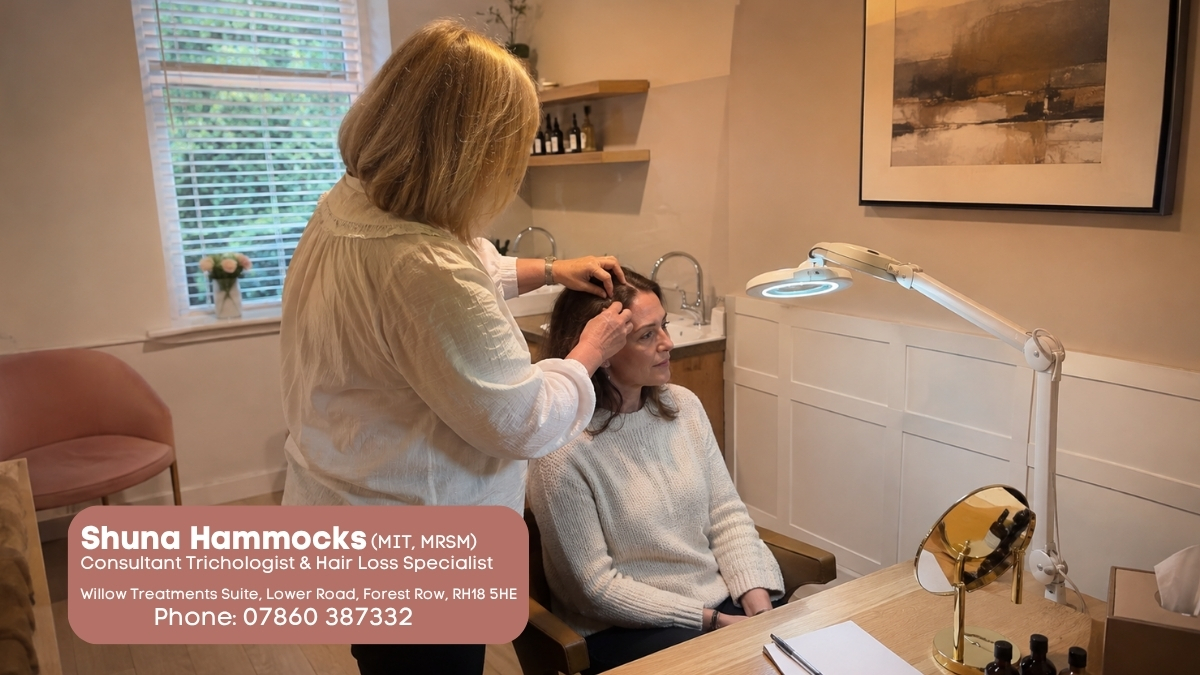
At our Forest Row clinic, Consultant Trichologist Shuna Hammocks (MIT, MRSM) reviews the history and pattern of your hair changes alongside your relevant medical history, medications, stress, family history, and scalp condition.
The hair and scalp are then examined in detail as part of the diagnostic process, helping to distinguish between increased shedding, gradual thinning, breakage and other hair or scalp concerns. Appointments can be arranged online or by calling 07860 387 332.
Clinical Sources Reviewed
- Clinical Reviewer: Shuna Hammocks, Consultant Trichologist, Member of The Institute of Trichologists (MIT), Registration No. 10060.
- Clinical Sources: The Institute of Trichologists, British Association of Dermatologists guidance on telogen effluvium, NHS hair loss documentation, and peer-reviewed dermatological literature on human hair follicle cycling.
Disclaimer: This article is for educational purposes only and does not constitute individual medical advice, diagnosis, or treatment planning.