How Much Hair Loss Is Normal When Washing or Brushing?
Seeing a bunch of hair in the shower, on your brush or around the bathroom can be surprisingly upsetting.
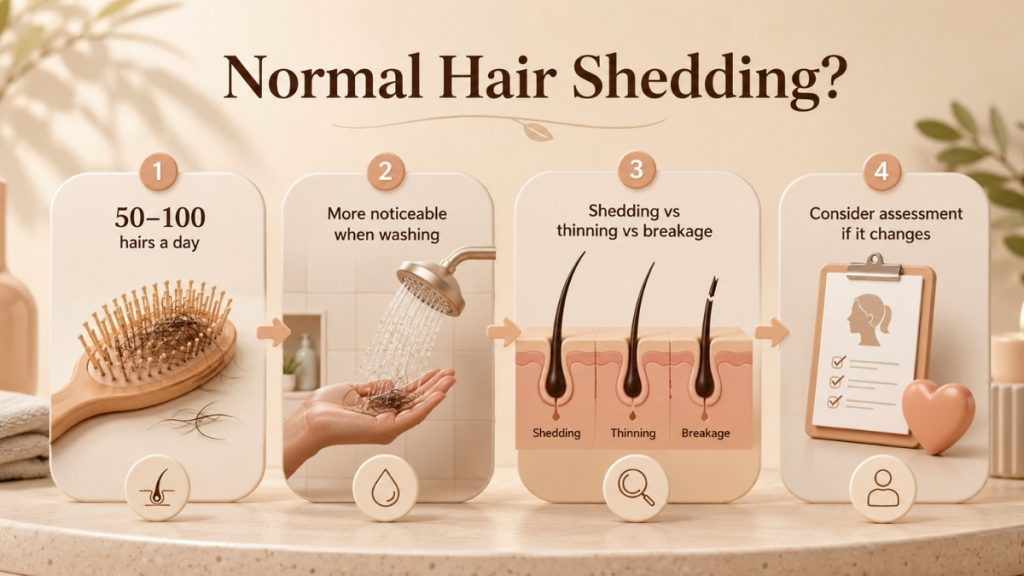
Some daily shedding is expected as part of the natural hair cycle. The NHS describes around 50–100 hairs per day as normal, while the British Association of Dermatologists gives a broader range of approximately 30–150 hairs. The Institute of Trichologists say up to 100 hairs lost is acceptable. However, the exact number varies considerably between individuals.
For this reason, counting individual hairs is rarely the most useful way to understand whether something has changed.
Why Does More Hair Seem to Fall Out When Washing?
Hair that has reached the shedding stage of its cycle, “Telogen”, eventually falls out from the scalp. Washing and brushing are often when these hairs become most noticeable, but those most concerned explain it’s everywhere: in the sink when brushing teeth, falling into food while cooking, and even clogging up the hoover.
Someone who washes or brushes less frequently may see several days of naturally shed hairs appear at the same time. Hair length, texture and styling habits can also affect how noticeable the amount appears. The British Association of Dermatologists notes that increased shedding is commonly first noticed in the shower, bath or hairbrush.

When Does Hair Shedding Become More Significant?
The change from your usual pattern can be more informative than an exact number.
Changes that may be noticeable include:
- Considerably more hair appearing during washing or brushing than previously
- Increased shedding continuing over a period of time
- A reduction in the speed of growth
- A noticeable reduction in overall hair density
- Hair shedding accompanied by scalp discomfort or altered sensations
Increased diffuse shedding can occur with conditions such as telogen effluvium, while other forms of hair loss may present as gradual changes in density rather than large amounts of hair suddenly appearing in the shower.
Is It Shedding, Thinning or Breakage?
These concerns can look similar from day to day but are not necessarily the same.
| Concern | What It May Look Like |
|---|---|
| Shedding | More full-length hairs appearing during washing, brushing, or throughout the day. |
| Thinning | A gradual reduction in visible density, such as a wider parting or more scalp showing. Not necessarily with shedding. |
| Breakage | Shorter, uneven pieces of hair caused by damage along the hair shaft and ends. |
More than one may also be present at the same time. Understanding which change is occurring is an important part of assessing a hair-loss concern, and seeking help promptly matters.
When a Hair Loss Consultation Can Help
Not knowing whether the amount of hair you are seeing is normal can itself become worrying. It is particularly difficult to judge when you have noticed a gradual change over several months.
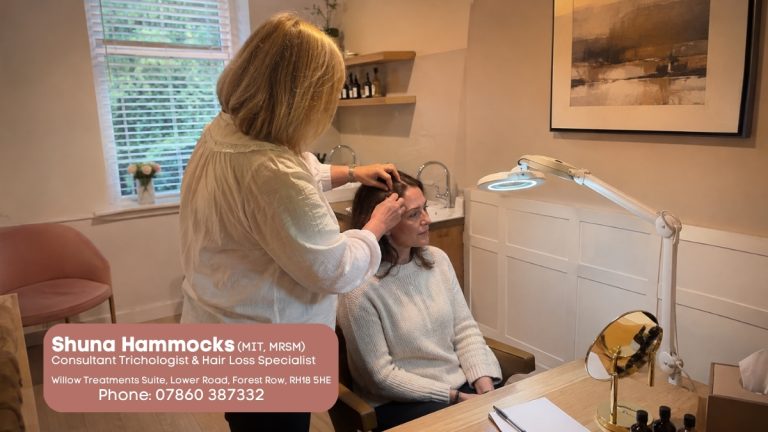
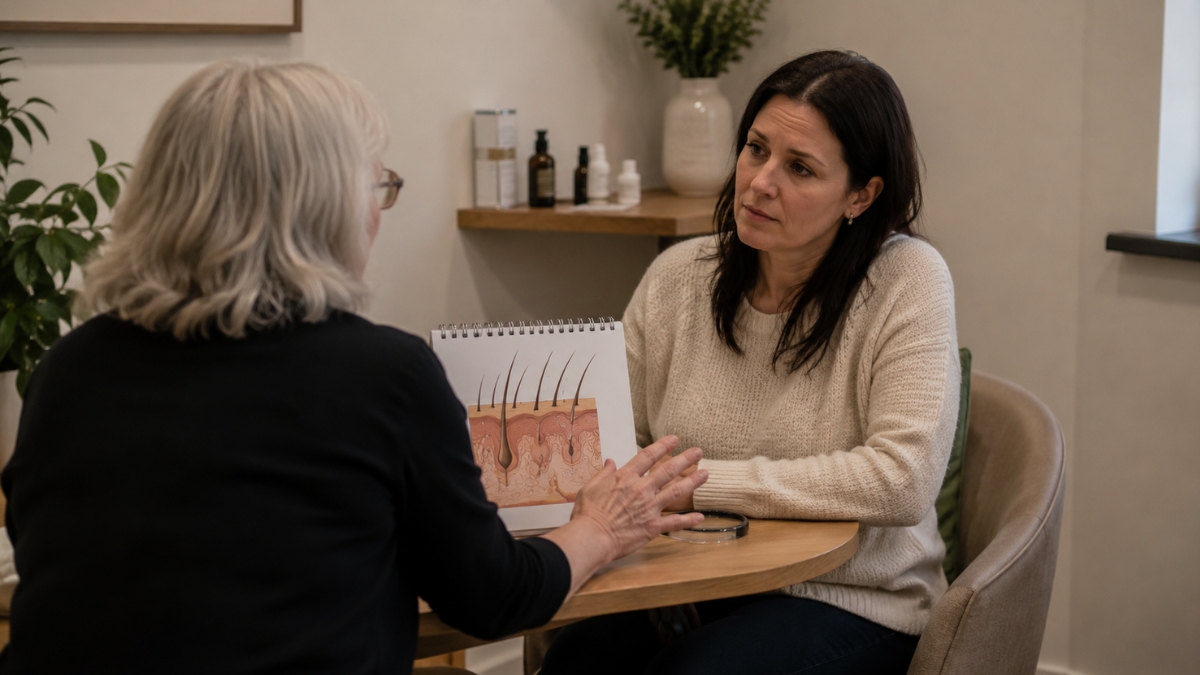
At Sussex Hair Clinic in Forest Row, Consultant Trichologist Shuna Hammocks (MIT) also looks beyond the number of hairs being shed. During a Hair Loss Consultation, Shuna considers when the change began, its pattern and progression, your medical and family history, medicines, your scalp condition, stress and other relevant factors.
The hair and scalp can then be examined to complete the diagnostic process.
The purpose is to understand what type of change is actually taking place, rather than assuming that seeing hair in the shower or brush means something is wrong.
Book Your Consultation in Sussex
If your normal pattern of shedding has noticeably changed, an individual assessment can help clarify what type of hair change is occurring. Book a Consultation at Sussex Hair Clinic to learn more about your hair and scalp health.
- Address: Willow Suite, Lower Road, Forest Row, RH18 5HE (Find us on Google Maps)
- Phone: 07860 387332
Clinical Sources Reviewed
This article was assessed for Sussex Hair Clinic and clinically reviewed by Shuna Hammocks, Consultant Trichologist, Member of The Institute of Trichologists (MIT), registration number 10060, before publication. Clinical sources reviewed include NHS guidance on hair loss and British Association of Dermatologists guidance on telogen effluvium.